
Omar Abdullah Pushes Examination Reforms in Jammu and Kashmir
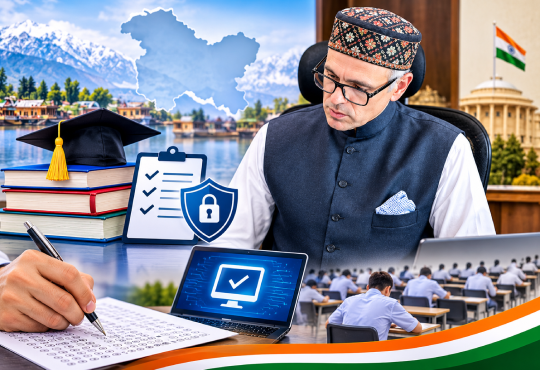
Jammu and Kashmir Chief Minister Omar Abdullah has called for comprehensive reforms in the examination system, emphasising stronger security, transparent evaluation and technology-driven assessments to protect students' futures. The proposed changes aim to strengthen examination credibility, reduce irregularities and ensure that merit remains the primary criterion in admissions and recruitment.
Chairing a meeting of the High-Powered Task Force (HPTF) on Examination Reforms at the Civil Secretariat in Jammu on November 12, Abdullah assured the panel of the government's support in developing a more reliable and student-friendly examination framework.
Gradual Shift Towards Computer-Based Examinations
One of the major proposals discussed was a gradual transition towards computer-based testing. The Chief Minister highlighted the importance of adopting technology to strengthen examination security and minimise the possibility of malpractice.
However, he stressed that students must become familiar with the technology before computer-based examinations are introduced on a wider scale. This would help candidates adapt to the new examination format without facing additional difficulties.
The need for stronger examination safeguards has become particularly important following the cancellation of the National Eligibility cum Entrance Test (Undergraduate) (NEET-UG) 2026 and the subsequent re-examination, which caused inconvenience and additional stress to lakhs of medical aspirants across the country.
"The need for robust examination reforms had become particularly evident following the cancellation of NEET-UG 2026 and the subsequent re-examination, which caused considerable inconvenience and additional stress to lakhs of aspirants across the country." - Omar Abdullah,Chief Minister,Jammu and Kashmir.
Board Examination Marks May Gain Greater Importance
Another significant proposal involves exploring the inclusion of school board examination performance in competitive and entrance examination selection frameworks.
The move could reduce students' excessive dependence on a single entrance examination while encouraging them to take regular school education more seriously.
However, implementing this approach would require a fair evaluation mechanism for students from different educational boards, including:
- Jammu and Kashmir Board of School Education (JKBOSE)
- Central Board of Secondary Education (CBSE)
- Indian Certificate of Secondary Education (ICSE)
Abdullah emphasised the need for an appropriate normalisation mechanism to ensure that students from different boards receive equal opportunities and are not disadvantaged because of variations in their assessment systems.
Greater Transparency in Interviews and Selection
The Chief Minister also raised concerns about the subjective nature of interviews and viva-voce assessments in recruitment and admission processes.
Candidates have frequently expressed concerns about the possibility of inconsistent marking and manipulation of interview scores. Abdullah suggested that the Task Force examine ways to make oral assessments more objective, transparent and accountable.
Such measures could strengthen confidence in recruitment examinations and admission procedures, particularly for students and young professionals competing for limited opportunities.
Stronger Security Across Examination Centres
The meeting also reviewed the security arrangements introduced by the Jammu and Kashmir administration for public examinations.
Some of the measures discussed and reviewed include:
Police-escorted transportation of examination materials.
- Closed-circuit television (CCTV)-monitored strong rooms for question paper storage.
- Round-the-clock security at designated facilities.
- Prescribed frisking procedures and continuous monitoring of examination centres.
- Coordination between civil and police authorities to strengthen examination management.
The meeting also reviewed examination-related improvements by the Jammu and Kashmir Public Service Commission (JKPSC), Jammu and Kashmir Services Selection Board (JKSSB), universities and other higher education institutions.
National-Level Examination Reforms Also Under Discussion
The High-Powered Task Force has been constituted by the Government of India to recommend comprehensive reforms in examinations conducted by the National Testing Agency (NTA).
Its scope includes major national examinations such as:
- National Eligibility cum Entrance Test (Undergraduate) (NEET-UG).
- Joint Entrance Examination (JEE) Main.
- Common University Entrance Test (Undergraduate) (CUET-UG).
- University Grants Commission National Eligibility Test (UGC-NET).
The panel is also examining examination design, security, institutional governance, the use of emerging technologies such as Artificial Intelligence (AI) and Blockchain, inclusivity and student well-being.
The discussions in Jammu and Kashmir reflect a broader effort to strengthen the examination ecosystem and build greater trust among students, parents and educational institutions.