A featured contribution from Leadership Perspectives: a curated forum reserved for leaders nominated by our subscribers and vetted by our editorial board.

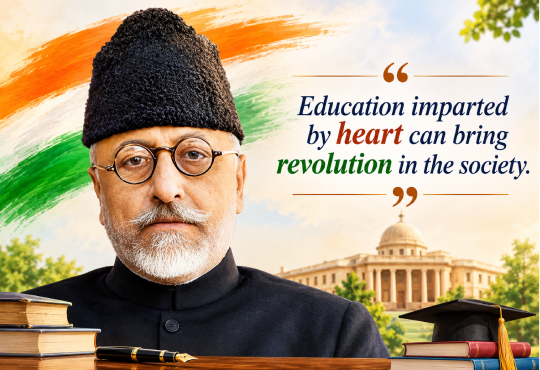
India observes National Education Day on November 11, 2026, to commemorate the birth anniversary of Maulana Abul Kalam Azad, independent India's first Education Minister. Born on November 11, 1888, Azad played an important role in shaping the country's education system during its formative years after Independence. The occasion highlights his commitment to accessible education, academic excellence, scientific learning and equal opportunities for students.
First celebrated in 2008, National Education Day encourages schools, colleges and universities to recognise education as an essential foundation for individual development and national progress. It also provides an opportunity to revisit Azad's contributions and understand how his ideas continue to influence India's educational landscape.
Who Was Maulana Abul Kalam Azad?
Maulana Abul Kalam Azad was a scholar, journalist, freedom fighter and educationist who became India's first Education Minister in 1947. He served in the position until his death in 1958.
Azad believed that education should reach every section of society rather than remain accessible only to privileged communities. He advocated free and compulsory education for children up to the age of 14, supported women's education and emphasised the importance of technical and vocational learning.
His vision extended beyond basic literacy. He believed that universities, research institutions and cultural organisations were equally important in developing an educated and progressive nation.
He expressed the importance of education through the following words:
"Education imparted by heart can bring revolution in the society." - Maulana Abul Kalam Azad
His belief in education as an instrument of social transformation shaped many of the priorities he pursued as India's first Education Minister.
Six Institutions That Reflect His Educational Vision
Several important educational and cultural institutions were established or developed during Azad's tenure, contributing to India's academic and cultural foundation.
1. Indian Institute of Technology (IIT) Kharagpur
Established in 1951, IIT Kharagpur became India's first Indian Institute of Technology. It marked an important step towards strengthening technical education and preparing skilled professionals for the country's industrial and scientific development. Azad formally inaugurated the institution on August 18, 1951.
2. University Grants Commission (UGC)
The University Grants Commission was formally inaugurated by Azad on December 28, 1953. It received statutory status in 1956 and became an important institution for coordinating university education and maintaining academic standards across the country.
3. Sangeet Natak Akademi
Established in 1953, the Sangeet Natak Akademi supports India's performing arts, including music, dance and drama. Its establishment reflected the importance of preserving cultural traditions alongside academic development.
4. Sahitya Akademi
Established in 1954, the Sahitya Akademi promotes Indian literature across different languages through publications, literary programmes and recognition of writers.
5. Lalit Kala Akademi
Established in 1954, the Lalit Kala Akademi encourages visual arts, including painting, sculpture and other artistic disciplines, supporting India's artistic heritage.
6. Indian Council for Cultural Relations (ICCR)
Established in 1950 with Azad as its founding president, the Indian Council for Cultural Relations promotes India's cultural relationships with other countries through educational and cultural exchanges.
Why His Vision Still Matters in 2026
India's education sector has expanded considerably, with growing attention to digital learning, skill development, research, innovation and industry-oriented education. However, access to quality education and equal learning opportunities remain important priorities.
Azad's emphasis on inclusive education continues to be relevant as educational institutions work to reach students from different economic and geographical backgrounds. His support for technical education also connects with today's growing demand for professionals equipped with skills in artificial intelligence, engineering, data science and emerging technologies.
His vision also reminds educational institutions that learning should not be restricted to examinations and academic qualifications. Creativity, critical thinking, cultural understanding and practical knowledge are equally important in preparing students for the future.
A Reminder for India's Education Community
National Education Day is an opportunity for students, teachers, parents, university leaders and policymakers to reflect on their responsibilities in building a stronger education system.
The first National Education Day celebrations were inaugurated in 2008 by then President Pratibha Devisingh Patil. During the occasion, she highlighted Azad's conviction that education is a tool of social transformation and emphasised his contribution to establishing important national education bodies.
As India observes National Education Day 2026, Maulana Abul Kalam Azad's legacy remains a reminder that the true value of education lies in creating opportunities, encouraging knowledge and enabling every individual to contribute to society.