A featured contribution from Leadership Perspectives: a curated forum reserved for leaders nominated by our subscribers and vetted by our editorial board.

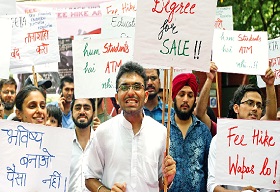
The ongoing student protests have highlighted deeper structural issues in India's education and employment ecosystem. Beyond immediate demands, they reflect growing concerns over limited job opportunities, skill mismatches, and the widening gap between economic growth and meaningful employment for young people.
India’s ongoing student protests have grown into one of the most significant social and political developments of the year, highlighting concerns that extend far beyond the immediate demands of demonstrators. What began as gatherings at Delhi’s Jantar Mantar has evolved into a nationwide conversation about the direction of higher education, youth employment, and the country’s economic priorities. Thousands of students and young graduates continue to participate in demonstrations, arguing that their frustrations are rooted not only in delayed recruitment and limited employment opportunities but also in deeper structural issues within India’s education and development model.
The protests gained additional national attention after social activist and educator Sonam Wangchuk began a hunger strike in solidarity with the students on June 28. Wangchuk, widely recognized for his work in education reform and sustainable development, called for meaningful engagement between policymakers and the country’s youth.
His fast ended after senior Union ministers J. P. Nadda and Jitendra Singh personally assured him that the government would address the concerns raised by the protesters through dialogue. While the end of the hunger strike has eased immediate tensions, student organizations have indicated that demonstrations are likely to continue until they see concrete policy measures and implementation.
At the center of the movement is growing anxiety about the gap between educational achievement and employment opportunities. India has expanded access to higher education significantly over the past decade, with millions of students enrolling in universities, engineering institutions, management schools, and vocational programs. However, many graduates argue that earning a degree no longer guarantees meaningful employment.
Delays in government recruitment, competitive examinations, and public sector appointments have intensified uncertainty for young job seekers who have invested years preparing for careers.
The demonstrations also reflect broader questions about the quality and relevance of education. Students believe that while enrollment has increased, many institutions continue to struggle with outdated curricula, limited industry collaboration, insufficient research infrastructure, and uneven faculty quality.
Also Read: Why Student Loans Are Becoming a Bigger Part of India's Education Story
Employers, meanwhile, frequently report skill gaps among graduates, creating a mismatch between academic qualifications and workplace expectations. As industries increasingly adopt artificial intelligence, automation, and digital technologies, students are demanding education that equips them with practical, future-ready skills rather than primarily theoretical knowledge.
Another concern emerging from the protests is the growing financial burden of higher education. Rising tuition costs, education loans, coaching expenses, and living costs have placed considerable pressure on middle-class and lower-income families. Many graduates now face the dual challenge of repaying educational investments while searching for stable employment in an increasingly competitive labor market. For many young people, this economic reality has created frustration that extends beyond individual career prospects and raises questions about social mobility.
Education experts note that India’s demographic advantage depends not only on having a large youth population but also on ensuring that young people have access to quality education, relevant skills, and productive employment. Without stronger alignment between educational institutions, industry needs, and labor market demand, the country risks underutilizing one of its greatest economic strengths.
The National Education Policy (NEP) 2020 introduced ambitious reforms aimed at promoting multidisciplinary learning, vocational education, digital learning, research, and flexibility in higher education. However, students and educators argue that implementation has been uneven across states and institutions, leaving many promised reforms yet to translate into measurable outcomes.
The protests have also highlighted the importance of restoring trust between policymakers and students. Many participants emphasize that they are seeking transparent recruitment processes, timely examinations, greater accountability, and sustained dialogue rather than short-term assurances. Analysts believe that addressing these concerns will require coordinated reforms across education, employment, and economic policy rather than isolated interventions.
As India positions itself as a global innovation and technology hub, the aspirations of its young population have become increasingly central to the country’s long-term growth story. The current wave of student protests serves as a reminder that educational expansion alone is not enough. Ensuring that learning leads to meaningful opportunities, equitable access, and economic security will be essential if India hopes to fully realize the potential of its demographic dividend and sustain inclusive growth in the years ahead.