A featured contribution from Leadership Perspectives: a curated forum reserved for leaders nominated by our subscribers and vetted by our editorial board.

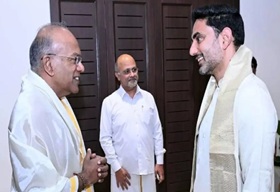
In a significant diplomatic and developmental engagement at Tirumala, Singapore Home Minister K. Shanmugam has extended a clear and consequential offer of partnership to Andhra Pradesh, pledging support for a comprehensive transformation of the state’s education system. The discussions with Education Minister Nara Lokesh signal more than courtesy; they mark a deliberate alignment between Singapore’s hard-won expertise and Andhra Pradesh’s ambitious reform agenda.
Shanmugam arrived in Tirumala on Monday night and was received by Lokesh. On Tuesday morning the two ministers jointly participated in the Suprabhata Seva, Thomala Seva and Archana Seva before Lord Sri Venkateswara. Immediately after the darshan they held substantive talks that ranged across education reforms, skill development, school retention, drug prevention and social security.
Lokesh presented the coalition government’s roadmap for education, detailing the structural changes already under way and the determined push to reverse the long-standing preference for private schools by strengthening government institutions. He outlined measures designed to keep children in classrooms, improve learning outcomes and create pathways from school to meaningful employment.
Shanmugam responded with appreciation and a concrete commitment. He stated that Singapore is prepared to share proven practices and extend practical cooperation to help Andhra Pradesh strengthen its education architecture. Crucially, he linked school retention directly to social protection, noting that children who remain in school are far less vulnerable to drugs and other destructive influences. He praised the state’s existing efforts to reduce dropouts and urged an even more aggressive pursuit of the zero-dropout goal.
The Singapore minister went further, expressing readiness to visit government schools across Andhra Pradesh and to support capacity-building that can deliver measurable results. This is not rhetorical solidarity; it is an offer of institutional partnership.
Drug control formed a second pillar of the conversation. Shanmugam described Singapore’s uncompromising framework of strict laws, deterrent penalties and sustained prevention programmes. He offered to transfer that experience so that Andhra Pradesh can design its own robust, context-specific strategy for a drug-free society. Both sides recognised that education and enforcement must move in tandem if the problem is to be contained.
Perhaps the most forward-looking element of the talks concerned technical and vocational education. The ministers explored a formal linkage between Andhra Pradesh’s Industrial Training Institutes and Singapore’s highly regarded Institute of Technical Education. Shanmugam explained how the ITE model keeps training tightly aligned with industry demand, producing graduates who enter the workforce job-ready. The two sides agreed to examine concrete mechanisms for collaboration that could equip Andhra Pradesh’s youth with employment-oriented skills at scale.
Beyond the policy substance, Shanmugam reflected on the spiritual dimension of the visit. Recalling a plaque he had seen years earlier behind the Executive Officer’s desk It’s not the darshan that you want, it’s the darshan that he gives” he described the present darshan as excellent and praised the arrangements made by the Tirumala Tirupati Devasthanams. He added that the visit had been especially meaningful in the company of Lokesh.
The Tirumala meeting carries strategic weight. Andhra Pradesh is seeking to reposition education as the foundation of both social stability and economic competitiveness. Singapore brings a track record of turning education and skills into national advantage. The convergence of these priorities opens a realistic pathway for knowledge transfer, institutional twinning and targeted capacity support.
Also Read: Gujarat Expands ITI Programs with AI, EV and Drone Courses
If the follow-up is pursued with seriousness, the partnership could yield tangible outcomes: fewer children leaving school, stronger government schools attracting students back from the private sector, tighter control over drug networks, and a new generation of skilled workers trained to industry standards. Those results would matter not only for Andhra Pradesh but as a demonstration of how focused international collaboration can accelerate state-level transformation in India.
The conversation at Tirumala has moved the relationship from goodwill to potential action. The test now lies in converting the commitments made on the sacred hill into sustained programmes on the ground.