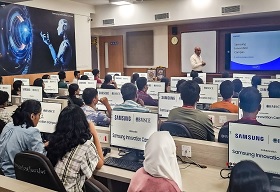
Samsung R&D Institute India, Bangalore (SRI-B) has expanded its flagship Samsung Innovation Campus (SIC) programme across leading academic institutions, reinforcing its global CSR vision, 'Together for Tomorrow! Enabling People'. The initiative is designed to equip youth with future-ready digital skills, fostering innovation and employability for the next generation.
In the current financial year, SRI-B has partnered with six premier colleges, including NITTE Meenakshi Institute of Technology, Christ (Deemed to be University), RV College of Engineering, SRM Institute of Science and Technology, Kattankulathur, BMS College of Engineering, and Dayananda Sagar College of Engineering, bringing the total number of participating institutions under SIC to 15. Among these, SRM Institute of Science and Technology is the only college from Tamil Nadu, while the remaining institutions are based in Karnataka.
Launched in September 2022, Samsung Innovation Campus is a global CSR and skilling initiative aimed at providing young learners with advanced digital skills. The programme offers specialised training across high-demand technology domains such as Artificial Intelligence (AI), Machine Learning (ML), Internet of Things (IoT), coding, and programming.
Also Read: TCS Expands LATAM Presence with New Brazil Campus, Creating 1,600 Jobs
The AI/ML curriculum includes neural networks, data processing, and hands-on AI projects, while the IoT track focuses on sensors, connectivity, cloud integration, and the development of smart devices. Students also receive instruction in programming fundamentals, Python, data structures, algorithms, and software engineering principles. Courses typically span six months and are guided by mentorship from SRI-B experts.
Celebrating 30 years in India, Samsung continues to emphasize empowering youth and strengthening grassroots innovation ecosystems. Mohan Rao Goli, Managing Director and CVP of SRI-B, highlighted that SIC bridges the gap between academia and industry while aligning with the government’s Skill India and Digital India missions. The programme has also achieved around 45% women participation, demonstrating Samsung’s commitment to building an inclusive technology ecosystem.
In addition to technical training, students benefit from soft-skills development to become workplace-ready. Alongside other initiatives like Samsung Solve for Tomorrow, Samsung Innovation Campus contributes to India’s digital skilling ecosystem, enabling young innovators to learn, create, and shape the future through technology. This initiative reinforces Samsung’s dedication to skilling youth, promoting digital literacy, and nurturing India’s next generation of tech leaders.