A featured contribution from Leadership Perspectives: a curated forum reserved for leaders nominated by our subscribers and vetted by our editorial board.

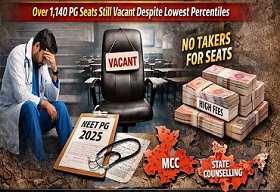
- 1,140 NEET PG seats remain vacant despite record-low cutoffs.
- Eligibility expanded, but high fees and low interest in non-clinical branches limit uptake.
- Fragmented counselling system adds logistical challenges, leaving seats unfilled.
Even after the Union Health Ministry slashed NEET-PG qualifying percentiles to historic lows, more than 1,140 postgraduate medical seats remain vacant, raising serious questions about India’s medical admission system. The revelation, shared in the Rajya Sabha on March 17, 2026, highlights a growing mismatch between eligibility and actual seat uptake.
To boost participation, the government lowered the cutoff to the 7th percentile for unreserved candidates and 5th percentile for PwD students, while effectively removing limits for reserved categories. Yet, despite this unprecedented expansion of eligible candidates, numerous specialisations went unclaimed even after the final stray vacancy round.
Also Read: IIT Madras Expands Vidya Shakti to Reach 10,000 More Rural Students
Experts point to structural issues beyond the entrance exam. High fees in private and deemed universities deter candidates, particularly in non-clinical branches like Anatomy, Physiology, and Biochemistry. Additionally, the fragmented counselling system split between the Medical Counselling Committee (MCC) for central quotas and various state authorities creates logistical hurdles that leave seats unfilled.
While the government defends NEET as a landmark reform ensuring transparency and fairness, the ongoing vacancy crisis underscores deeper challenges in medical education planning. The focus now is on bridging the gap between eligibility and interest, ensuring that India’s growing pool of doctors can find training opportunities across all specialisations.
The situation serves as a stark reminder that policy reforms alone may not suffice structural, financial, and administrative factors must align to prevent key medical seats from going to waste.