A featured contribution from Leadership Perspectives: a curated forum reserved for leaders nominated by our subscribers and vetted by our editorial board.

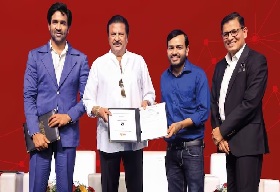
Mohan Babu University (MBU) has formalised a strategic collaboration with Physics Wallah (PW) to embed industry-oriented skills and practical training into its degree programmes. The partnership aims to bridge the gap between classroom learning and workplace expectations, giving students stronger preparation for careers in technology-driven fields.
The agreement was signed through a Memorandum of Understanding at MBU’s Tirupati campus. Dr M. Mohan Babu, Chancellor of Mohan Babu University, and Alakh Pandey, Co-Founder and CEO of Physics Wallah, exchanged the documents in the presence of Pro-Chancellor Vishnu Manchu, Trustee Vinay Maheshwari, senior faculty members and students.
The collaboration responds to shifting demands in the job market. While academic knowledge remains essential, employers increasingly seek graduates who can apply concepts, adapt to new technologies, demonstrate analytical thinking and communicate effectively. India’s youth employability stood at 54.8 per cent in 2025 according to the Human Capital for Viksit Bharat report. The World Economic Forum’s Future of Jobs Report 2025 highlights analytical thinking, adaptability, technological literacy, artificial intelligence and big data as capabilities that will grow in importance.
Under the partnership, MBU students will access learning programmes developed with PW Skills. Skill development will not be treated as a last-minute addition before placements. Instead, it will be woven into the regular academic journey. Students will engage with practical assignments, technology-based modules and projects that connect theoretical concepts to real-world applications. Industry professionals will conduct sessions to explain how skills are used in professional settings.
Career readiness support forms another core element. Students will receive guidance in aptitude development, communication and soft skills, subject-specific knowledge, role-specific competencies and interview preparation. The programme follows a two-mentor model. Professionals from PW Skills will provide an industry perspective, while MBU faculty mentors will offer academic guidance and continuous support.
Learning modules will be delivered across three semesters rather than compressed into a short intensive period. This structure allows students to absorb, practise and refine their skills while continuing their regular university coursework. Participants can choose industry-oriented tracks in Data Analytics and Data Science, Artificial Intelligence and Machine Learning, Full Stack Development, and Digital Marketing areas selected because of the growing role of data, automation, software and digital platforms across sectors.
Also Read: Mohan Babu University Adds Industry-Readiness To BTech 2026 Curriculum
The collaboration builds on Mohan Babu University’s existing efforts to combine traditional academics with technology, professional development and international exposure. Established with 34 years of experience in education, MBU offers more than 108 programmes and serves a community of over 18,000 students. Its academic portfolio spans engineering and computing, management, commerce, liberal arts and sciences, pharmaceutical sciences, health sciences, agriculture and nursing. The university holds NAAC A+ accreditation and a QS I-GAUGE Diamond rating.
Technology education already features prominently at MBU. Programmes cover Artificial Intelligence and Machine Learning, Artificial Intelligence and Data Science, Cyber Security, Data Science, Cloud Computing and DevOps, among other emerging domains. The university has also expanded its international footprint through a Joint Degree Programme collaboration with Penn State University and an academic association with RWTH Aachen University in Germany.
In addition to academic partnerships, MBU runs several initiatives focused on professional preparedness. These include the Top Gun programme, the Continuous Evaluation Program for Placement Readiness, English proficiency training and specialised skill-development courses. The university also emphasises research, entrepreneurship and innovation to help students develop capabilities beyond conventional classroom instruction.
Vishnu Manchu, Pro-Chancellor of Mohan Babu University, said: “Students are entering professional environments that are changing faster than ever. At MBU, our focus is on helping them respond to that change with strong fundamentals, relevant practical experience and consistent mentorship. Through our association with PW Skills, students will gain additional learning opportunities in areas such as artificial intelligence, data and digital technologies while continuing their academic programmes.”
Vinay Maheshwari, Trustee of Mohan Babu University, added: “Preparing students for their careers should be a continuous process that begins well before the placement stage. Through the two-teacher model, students benefit from the practical perspective of industry professionals as well as the academic support of MBU faculty. Conducting the programme over three semesters gives them the opportunity to build their abilities gradually through consistent learning and application.”
Alakh Pandey, Co-Founder and CEO of Physics Wallah, noted: “A strong academic foundation is essential, but succeeding in today’s professional environment also requires students to know how to put their learning into practice. Through this collaboration, we aim to introduce students to hands-on learning and industry perspectives during their university education, helping them better understand workplace expectations and prepare for their transition into professional roles.”
The partnership between MBU and PW Skills integrates academic instruction, practical application and professional preparation into a single learning framework. By introducing industry interaction and skill development during the degree programme itself, the initiative seeks to help students understand how classroom knowledge connects with professional requirements. As technology continues to reshape job roles and workplace expectations, the collaboration is designed to equip students with both subject knowledge and applied capabilities, enabling them to approach their careers with greater confidence and readiness.