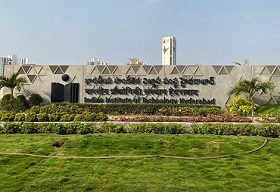
The Indian Institute of Technology Hyderabad (IITH) has launched India's first industry-academia collaborative program in nuclear technology, marking a major step toward strengthening the country's talent pipeline for one of its most strategically important sectors.
The initiative is designed to bridge the longstanding gap between classroom education and the practical demands of the nuclear industry by combining academic rigor with direct industry participation. At a time when India is expanding its clean energy ambitions and investing heavily in advanced nuclear infrastructure, the program is expected to prepare a new generation of engineers and scientists with specialized knowledge and real-world skills tailored to the evolving needs of the sector.
Unlike conventional engineering courses that primarily emphasize theoretical instruction, the new program has been developed in close collaboration with industry experts, allowing students to gain exposure to practical applications, operational challenges, regulatory standards, and emerging technologies in nuclear science and engineering.
The curriculum aims to create graduates who are better equipped to transition directly into the workforce, reducing the gap between academic learning and industrial requirements. This collaborative approach reflects a growing trend in higher education, where institutions are increasingly partnering with industry to ensure graduates possess job-ready skills in highly specialized fields.
The launch comes at a critical time for India's energy sector. As the country works toward achieving its long-term clean energy and net-zero commitments, nuclear power is expected to play an increasingly significant role alongside renewable sources such as solar and wind.
Expanding nuclear capacity requires not only technological investments but also a highly skilled workforce capable of designing, operating, maintaining, and advancing sophisticated nuclear systems. By introducing a dedicated industry-integrated academic program, IIT Hyderabad is seeking to address this growing demand while supporting India's broader energy security objectives.
Also Read: IIT Hyderabad Launches Nuclear Technology Training Program
The initiative also reinforces IIT Hyderabad's reputation as one of India's most innovation-driven engineering institutions. Since its establishment in 2008, the institute has consistently introduced industry-oriented academic programs and interdisciplinary curricula that respond to emerging technological trends.
It was among the first IITs to introduce specialized programs in Artificial Intelligence and has built a strong ecosystem around research, innovation, entrepreneurship, and industry collaboration. The institute today hosts more than 30 centers of excellence, has supported hundreds of startups, and maintains partnerships with organizations across India and internationally, enabling students to work on real-world technological challenges beyond traditional classroom settings.
The nuclear technology program further strengthens this industry-focused educational philosophy by bringing experienced professionals into the learning process. Students are expected to benefit from exposure to practical case studies, advanced engineering applications, and contemporary developments shaping the global nuclear industry.
Such interactions can help learners better understand complex technologies while preparing them for careers spanning nuclear energy production, reactor engineering, radiation safety, research laboratories, advanced manufacturing, and allied high-technology sectors. The emphasis on experiential learning is expected to make graduates more competitive in an increasingly specialized employment landscape.
Industry-academia partnerships have become a growing priority across higher education as employers seek graduates with practical expertise rather than purely academic credentials. Programs co-developed with industry not only improve employability but also accelerate innovation by allowing educational institutions and companies to jointly address technological challenges.
In highly regulated sectors such as nuclear technology, where precision, safety, and continuous technological advancement are paramount, such collaborations become even more valuable in developing future-ready professionals.
The introduction of India's first industry-academia collaborative course in nuclear technology signals a broader evolution in engineering education, where universities are moving beyond traditional teaching models to create learning environments that closely mirror industry needs.
As India continues investing in advanced energy technologies and expanding its scientific capabilities, initiatives like this are expected to play an important role in developing the skilled workforce necessary to support the country's long-term technological and economic ambitions while strengthening its position as a global center for engineering excellence and innovation.