A featured contribution from Leadership Perspectives: a curated forum reserved for leaders nominated by our subscribers and vetted by our editorial board.

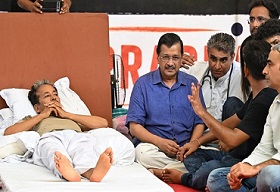
AAP leader Arvind Kejriwal has backed Sonam Wangchuk’s protest over examination irregularities and suggested appointing him as education minister instead of Dharmendra Pradhan. The remark has triggered a wider debate over education reforms, exam security, and political solutions to student concerns.
The ongoing protest by educator and climate activist Sonam Wangchuk over examination irregularities has gained political attention after former Delhi Chief Minister and AAP national convener Arvind Kejriwal joined the protest at Jantar Mantar in New Delhi.
Kejriwal extended his support to Wangchuk’s indefinite hunger strike and called for the removal of Union Education Minister Dharmendra Pradhan. He also suggested that Wangchuk could take over the role, a statement that has sparked discussion around whether leadership changes alone can address India’s education challenges.
In a post on X, Kejriwal said, "Sonam Wangchuk should be appointed as the country's education minister by removing Dharmendra Pradhan".
Addressing protesters, Kejriwal criticized the government over repeated examination-related issues, including paper leaks and concerns around evaluation systems. He said such incidents have affected the trust of students and parents in the examination process.
Kejriwal said, "Exam papers are being leaked constantly, day after day. There are irregularities in the papers and flaws in the evaluation process... When the NEET paper leaked, 20 students committed suicide, yet the government took no measures to assure anyone that leaks wouldn't recur. Further leaks followed the NEET incident, and the CBSE evaluation system was compromised, yet no action was taken against the company involved".
He further urged the government to respond to the concerns of young people and take stronger measures to improve transparency in competitive examinations.
He added, "It appears the government is consumed by arrogance. I want to tell the government: either listen to the voice of the youth, or these very young people will throw you out of power in 2029... I urge the Prime Minister and the country's 1.4 billion citizens to desire that Sonam Wangchuk be appointed as the education minister in his place".
Wangchuk’s protest began on June 28, with demands focused on accountability over examination irregularities and improvements in the education system. His hunger strike has now entered its 19th day, with doctors warning about the impact of prolonged fasting on his health.
According to his medical team, Wangchuk has lost more than 9 kg and currently weighs 56.9 kg. Doctors said his health is being monitored continuously and warned that prolonged fasting could increase the risk of serious medical complications.
Also Read: IIMA Establishes Mattu Centre To Boost Finance Research And Market Studies
Dr Satish Lamba, Wangchuk’s attending physician, says,"Today, on the 19th day of hunger strike, his total weight loss exceeds 9 kilograms. His blood sugar today is 80 mg/dL, and his pulse is 72 beats per minute. His blood pressure readings are 105/61 mmHg while lying down and 101/65 mmHg while sitting" .
Doctors said Wangchuk remains hydrated and mentally alert but has entered the second stage of prolonged starvation, which could lead to health complications if the hunger strike continues.
Meanwhile, other political leaders have also expressed support for Wangchuk’s protest. Samajwadi Party MP Dimple Yadav visited Jantar Mantar and extended her support.
While Kejriwal’s suggestion of appointing Wangchuk as education minister has generated political debate, the larger question remains whether individual leadership changes can address deeper issues within India’s education system. Experts have often pointed to the need for stronger examination security systems, better governance, technology-driven monitoring, and faster grievance resolution mechanisms.
The debate around Wangchuk’s protest highlights growing concerns among students and families about the reliability and fairness of competitive examinations. Whether the solution lies in changing leadership or strengthening institutional reforms remains a key question for policymakers.