
Children's Day 2026 and Chacha Nehru's Vision for India
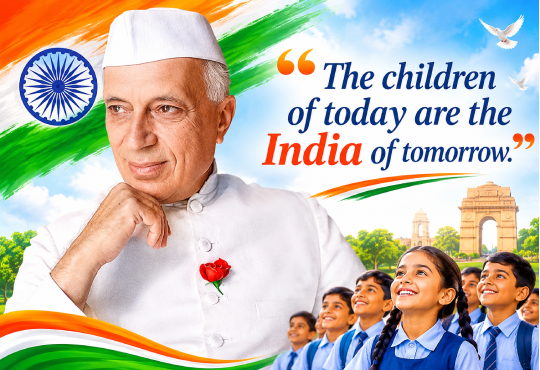
Every year on November 14, India celebrates Children's Day, also known as Bal Diwas, to recognise the importance of children and their role in shaping the country's future. The day marks the birth anniversary of Pandit Jawaharlal Nehru, India's first Prime Minister, who was deeply associated with children's welfare, education and development. Popularly remembered as Chacha Nehru, he believed that children were the foundation of a strong and progressive nation.
However, Nehru's contribution to India went far beyond his affection for children. He was a freedom fighter, political leader, writer and nation-builder whose ideas influenced India's educational, scientific and institutional development. His life offers an important perspective on why education, curiosity and opportunities for young minds matter to a country's future.
Who Was Jawaharlal Nehru?
Pandit Jawaharlal Nehru was born on November 14, 1889, in Allahabad, now known as Prayagraj, Uttar Pradesh. He was the son of Motilal Nehru, a prominent lawyer and political leader, and Swarup Rani Nehru.
Nehru grew up in a privileged family environment at Anand Bhawan in Allahabad. He had two sisters, Vijayalakshmi Pandit and Krishna Hutheesing. His early education took place at home under private tutors, where he developed an interest in reading, science and world affairs.
At the age of 15, he travelled to England to continue his education. He studied at Harrow School before joining Trinity College, Cambridge, where he pursued Natural Sciences. He later studied law at the Inner Temple in London and returned to India in 1912.
Although he initially trained as a barrister, his growing interest in India's political situation gradually drew him into the freedom movement.
From Freedom Fighter to India's First Prime Minister
Nehru's involvement in Indian politics began in 1912 when he attended the Bankipore session of the Indian National Congress. His meeting with Mahatma Gandhi in 1916 had a significant influence on his political journey.
He actively participated in the Non-Cooperation Movement, Civil Disobedience Movement and Quit India Movement. His association with the independence struggle also led to several arrests, and he spent approximately nine years in prison between 1920 and 1945.
In 1929, Nehru presided over the Lahore session of the Indian National Congress, where the demand for complete independence, or Purna Swaraj, was adopted as the party's goal.
Following India's independence on August 15, 1947, Nehru became the country's first Prime Minister. He held the position until his death on May 27, 1964.
As Prime Minister, he faced the enormous responsibility of building a newly independent nation. His government focused on democratic institutions, industrial development, scientific research, education and economic progress.
Jawaharlal Nehru's Contribution to Indian Education
Nehru believed that education was essential for developing an independent, progressive and self-reliant India. He viewed learning, scientific thinking and research as important foundations for national development.
His government supported the development of institutions that would strengthen higher education, technical knowledge and scientific research.
1. Strengthening Technical Education Through IITs
One of Nehru's important contributions was his support for the development of the Indian Institutes of Technology (IITs). He recognised the need for highly trained engineers, scientists and technical professionals who could contribute to India's industrial and technological growth.
IIT Kharagpur, the first institution in the IIT system, was established in 1950 and formally inaugurated in 1951. Nehru played a pioneering role in promoting the IIT system, which later expanded to other parts of the country.
2. Supporting Higher Education and Research
Nehru's vision extended beyond engineering education. He supported the growth of universities, research institutions and centres of scientific excellence.
The University Grants Commission (UGC), which became a statutory body in 1956, played an important role in coordinating university education and maintaining academic standards. Nehru addressed its inaugural meeting in December 1953.
His government also supported the growth of institutions in medical education, management, science and other fields, helping establish a stronger foundation for India's higher education system.
3. Promoting Scientific Temper and Innovation
Nehru strongly believed that scientific thinking should become part of everyday life. He encouraged people to question assumptions, examine evidence and develop a rational approach to problems.
His vision contributed to the growth of scientific research infrastructure, including national laboratories under the Council of Scientific and Industrial Research (CSIR), as well as developments in atomic energy and technology.
He believed that science and research could help India address major challenges such as poverty, hunger and underdevelopment.
4. Encouraging Education as a Foundation for Nation-Building
For Nehru, education was not limited to obtaining degrees or securing employment. He viewed it as a way to develop independent thinking, social responsibility and the ability to contribute to society.
His broader vision placed importance on creating institutions and opportunities that could prepare future generations to participate in India's development.
Why Was Jawaharlal Nehru Called Chacha Nehru?
Nehru shared a close association with children and was popularly known as Chacha Nehru. His affection for young people and his belief in their potential made him a familiar and respected figure among children.
He believed that children should receive opportunities to learn, play, explore their interests and develop their abilities. He also recognised that their growth depended on the support of families, schools and society.
During a Children's Day address at the National Stadium in New Delhi on November 14, 1957, he spoke about the importance of children's role in the country's future.
He said:
"Children are like flowers and by your good qualities you should make the country fragrant."
He encouraged children to read, write, play, dance and sing, highlighting the importance of happiness and a well-rounded childhood.
Why Is November 14 Celebrated as Children's Day?
India celebrates Children's Day on November 14 to mark Nehru's birth anniversary and recognise his association with children's welfare.
An interesting historical detail is that Nehru did not want the occasion to become a personal birthday celebration. In a note dated November 13, 1957, he expressed that the personal element of his birthday should not be mixed with Children's Day.
In his address the following day, he also said that November 14 should be celebrated as Children's Day and that it was only a coincidence that the date was his birthday.
The occasion subsequently became an annual reminder of the importance of children's rights, education, health, safety and overall development.
Today, schools across India mark the day through cultural programmes, competitions, activities and special events that celebrate childhood.
Jawaharlal Nehru as a Writer and Thinker
Apart from politics and education, Nehru was also a prolific writer. His experiences, ideas and observations about history, society and India's future found expression in several books.
Some of his well-known works include:
The Discovery of India: Written during his imprisonment at Ahmednagar Fort, the book explores India's history, culture, civilisation and identity.
Glimpses of World History: A collection of letters written to his daughter, Indira Gandhi, explaining world history and major historical developments.
An Autobiography: A personal account of his life, political journey, beliefs and experiences.
Through his writings, Nehru encouraged readers to understand history, develop broader perspectives and think critically about the world.
Remembering Nehru's Vision on Children's Day 2026
Jawaharlal Nehru's legacy remains connected to India's political, educational and scientific development. His emphasis on education, research and scientific thinking helped shape the country's approach to building institutions and preparing future generations.
For students, parents and educators, his association with Children's Day offers a reminder that every child deserves access to meaningful learning, opportunities to explore and an environment that supports their growth.
As India celebrates Children's Day 2026 on November 14, remembering Nehru is also an opportunity to reflect on the responsibilities of families, schools and institutions in nurturing young minds. His message continues to underline an important idea: the future of a nation depends greatly on how it educates, encourages and cares for its children.