How Industry-Academia Partnerships Reshape India's Education System
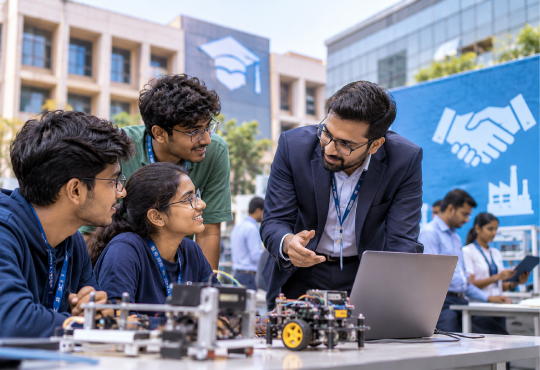
India's education system is witnessing a shift as universities and businesses increasingly work together to prepare students for changing industry requirements. With artificial intelligence, automation, digitalisation and emerging technologies transforming workplaces, academic institutions are recognising the need to connect classroom learning with practical industry experience.
Industry-academia partnerships are becoming an important part of this transformation. These collaborations bring universities, companies, research institutions and technology organisations together to develop industry-relevant courses, strengthen research, provide practical training and create employment opportunities. While businesses gain access to skilled talent and research capabilities, students benefit from exposure to real-world challenges and professional environments.
Bridging the Gap Between Education and Employment
One of the major challenges facing higher education is the gap between academic knowledge and industry expectations. Traditional classroom learning provides students with theoretical foundations, but employers increasingly seek practical experience, technical expertise, communication skills and problem-solving abilities.
Industry partnerships help address this gap by allowing companies to participate in curriculum development, offer internships, conduct specialised training programmes and provide live projects. Students can understand workplace expectations while applying their academic knowledge to practical situations.
The National Education Policy (NEP) 2020 also emphasises vocational education, practical exposure, multidisciplinary learning and stronger connections between educational institutions and industries.
Some of the important areas of collaboration include:
- Industry-designed courses aligned with current job requirements.
- Internships and apprenticeship opportunities for students.
- Live projects that address actual business challenges.
- Industry experts participating in academic programmes.
- Practical training in emerging technologies and specialised fields.
Academic Institutions and Businesses Must Complement Each Other
The success of industry-academia partnerships depends on how effectively universities and companies combine their strengths. Academic institutions contribute research capabilities, fundamental knowledge and specialised expertise, while businesses bring market understanding, commercial experience and opportunities to implement innovations.

Prof. Rajat Moona, Director, Indian Institute of Technology (IIT) Gandhinagar, has highlighted the importance of combining these complementary strengths.
Prof. Moona brings extensive experience across academic research and technology development. Before taking charge as Director of IIT Gandhinagar in 2022, he served as Director of IIT Bhilai and Director General of the Centre for Development of Advanced Computing (C-DAC). He also spent several years at IIT Kanpur, contributing to technology development in areas such as smart cards, examination automation and electronic toll collection.
Speaking at IIT Gandhinagar's CoLab 2024 industry open house, he said:
"The industry-academia relations can succeed when one complements the strength of the other."
His observation highlights why collaboration should go beyond campus recruitment. Universities and businesses need to work together on research, technology development and practical problem-solving to create outcomes that benefit students, institutions and industries.
Corporate Participation Is Driving Industry-Relevant Learning
Businesses are increasingly recognising that educational institutions can become long-term partners in developing talent and strengthening innovation. Rather than limiting their involvement to recruitment, companies can support specialised laboratories, research centres, technical training and collaborative projects.
 Amit Gossain, Managing Director, KONE Elevator India and South Asia, also serves as Chairman of the CII Industry-Academia Partnership Forum. He has emphasised the importance of bringing corporate expertise and academic research together.
Gossain's professional experience includes leadership roles at KONE, JCB, CNH Industrial and Larsen & Toubro (L&T). His experience across manufacturing, sales, marketing and business strategy reflects the growing importance of aligning education with the practical requirements of industrial sectors.
In a statement published by CII, he said:
"Today, the fusion of industry expertise and academic research has become more crucial than ever."
He further highlighted that synergy between the two sectors fosters innovation, drives economic growth and addresses complex societal challenges.
Research and Innovation Create New Business Opportunities
Industry-academia partnerships are also strengthening India's research and development ecosystem. Companies can work with universities to develop new products, improve existing technologies, explore emerging innovations and address sector-specific challenges.
These collaborations are particularly valuable in areas such as:
- Artificial intelligence and machine learning.
- Biotechnology and healthcare.
- Renewable energy and sustainability.
- Semiconductor technology and advanced manufacturing.
- Cybersecurity and digital infrastructure.
For example, IIT Gandhinagar signed a Memorandum of Understanding (MoU) with DigiTruce Private Limited in May 2026 to promote collaborative research, technology development and student skill-building in areas such as cybersecurity, artificial intelligence, robotics and automation.
The agreement also provides opportunities for joint research projects, internships, live industry projects and technology commercialisation.
Such arrangements can help businesses access specialised research capabilities while giving universities opportunities to translate academic knowledge into practical applications.
Preparing Students for a Future-Ready Workforce
The benefits of these partnerships extend beyond institutional research and corporate innovation. Students gain opportunities to understand professional environments, develop practical skills and become familiar with the expectations of employers.
Internships, apprenticeships, industry-led training and collaborative projects can help learners build confidence and improve their transition from education to employment.
The National Apprenticeship Training Scheme (NATS), for instance, provides eligible graduates and other learners with workplace training through participating establishments. Such initiatives demonstrate how structured industry exposure can complement formal education.
For students, the major benefits include:
- Better understanding of industry expectations.
- Opportunities to gain hands-on experience.
- Exposure to emerging technologies and business practices.
- Improved technical and professional skills.
- Stronger employment and career development opportunities.
- Strengthening India's Education and Business Ecosystem
As India's economy expands and demand for specialised talent increases, industry-academia partnerships are becoming increasingly important. Universities can strengthen their academic relevance and research capabilities, while companies can develop talent pipelines, accelerate innovation and address changing workforce requirements.
However, successful collaborations require long-term commitments, adequate funding, clearly defined objectives and continuous communication between educational institutions and businesses.
The future of India's education system will depend not only on academic excellence but also on how effectively institutions connect learning with industry requirements. Stronger partnerships can create an ecosystem where students gain relevant skills, businesses benefit from research-driven innovation and universities contribute more directly to India's economic development.